
Site Dialogues
Aono Fumiaki
25 Sep 2026
Editor: For the IVAE Pavilion, you stayed in Gwangju four weeks and began your project not by making, but by collecting discarded materials. Could you tell us about the significance of collecting in your practice—how you select materials, and how these encounters with found objects shape the improvisational process that follows?
Aono Fumiaki: Gathering materials is especially important to me in my art practice. This stems from the concept of “restoration and regeneration” that underlies my work. It is not simply about gathering materials. The artist’s conception or image does not necessarily come first. Rather, the image emerges through the process of trying to complete the collected materials and fragments.
Surprisingly, when I arrived in Gwangju, I had nothing in mind. I didn’t even have an image.The only thing that initially came to mind was an image of Kim Dae-jung in a white robe in a scene related to his death sentence.
My impression of Gwangju Theatre, on the other hand, was completely different. It was overflowing with forms, movie characters, faces, poses, figures, images and colours, all imbued with the rich and beautiful depth of its long history. In a sense, it was close to the kind of world I had been pursuing in my own work.
Leaving Gwangju Theatre for a while, I began to wonder: what should I encounter first in the city, and what should I collect? From there, I started completely from a blank slate.
Normally, I don’t create works based on predictions, plans or predetermined images. This time, however, considering both the location—Gwangju Theatre—and the limited production period, I needed to focus my collecting to some extent and produce results within a short period of time. Rather than creating something completely different from or unrelated to Gwangju Theatre—or making a more powerful work that would somehow compete with it—I wanted to create a work that could draw out the character and appeal of the site, allowing the work and the theatre to produce a kind of synergy.
I began by collecting things connected to everyday life and to people, without overthinking the process. At the same time, I collected materials that could complement and expand the forms I was developing: plywood, furniture, books, piles of flyers and other found materials. I also drew on experience from my previous works: expanding a form from fragments and gradually constructing a figure.
With this in mind, I focused on collecting objects that could suggest or become particular parts of the body:
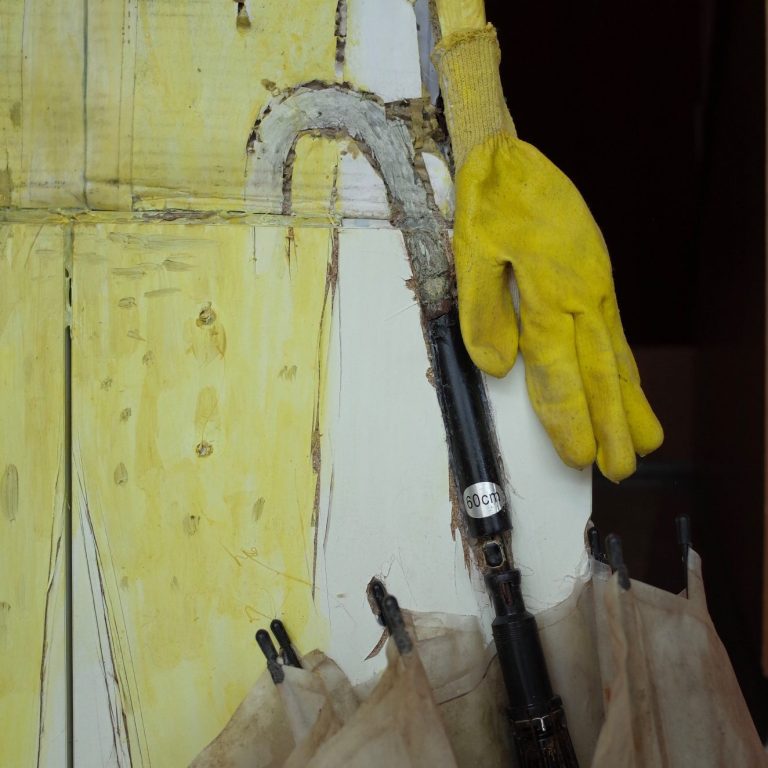
- Fingertips / hands: gloves and personal belongings such as umbrellas, cups and cigarettes, as well as shirts
- Feet / legs: shoes, socks and trousers
- Top of the head: hats
- Face: masks and glasses
I was surprised that I didn’t find as much printed material, particularly magazines, as I had expected. According to Mr. Yoon, social media and digital media are now widespread in Korea, while print media is in decline. Magazines are not distributed as widely as they are in Japan. In the end, my research was largely limited to posters and flyers found on the streets, as well as old magazines collected from abandoned sites. Through these materials, I attempted to visualise a variety of figures: different types—real people, photographs, illustrations, comics and so on—as well as different sizes, materials, appearances, clothing, poses, genders, ages and eras.
At the same time, the contextual and semantic fragments contained within these materials begin to influence one another. I think of the work as operating across three spaces or stages: inside the theatre’s auditorium, outside it, and in the city itself. Or, in another sense: inside the work, around its periphery, and in the real world beyond the work. I am particularly interested in this “periphery”—in expanding the space where fiction and reality intersect, somewhere between the work and the real world. And, alongside it, there is also that whisper.
To be honest, four weeks—effectively three weeks—was far too short. Perhaps, with more time, I could have carried out a wider range of collecting and sorting. But from experience, I know that rich or compelling things do not always emerge from an abundance of material. Unexpected results often come instead from just a few fragments. In this case, I am satisfied because the limited materials were able to function efficiently in the right places, producing the maximum result. When there is a kind of “material inflation” caused by an overabundance of materials, the process of transforming fragments, recreating images and connecting them can become unclear. The work can begin to resemble an accumulation of objects, a collage, or junk art. Under limited conditions—and perhaps the more limited the conditions, the clearer this becomes—an optimal solution can emerge almost automatically: “There is no other way,” or “This is the most natural thing to do.” Within the framework of the choices available, a sense of inevitability emerges, and what needs to be done becomes clear.
I also thought about the meanings of the various things encountered in a movie theatre. Because I couldn’t read the subtitles and wasn’t familiar with many of the films, I probably saw them differently from Korean viewers. A famous actor, a famous film, a story I couldn’t understand, a variety of images, combinations of unfamiliar characters—the cinema billboard could appear to me almost as a single scene in itself. Perhaps the meaning and story of a film are fully known only to the audience watching it, or to those involved in it. In a similar way, every scene in everyday life may appear this way to an outsider. Its meaning may be ambiguous or difficult to understand, while for those involved—or for a particular individual—it may hold enormous significance: an irreplaceable moment, a once-in-a-lifetime event or scene.
Every day, every hour, countless such events exist for each viewer and each person involved. The question is how they are selected, brought into focus, privileged and elevated into works of art. Ultimately, perhaps it is simply a question of whether something is treated as a work of art or not.
- Real world → Ideas / Images → Works, Stories, Films → Fragments of Scenes / Condensation → Billboards
- Real world → Images, Scenes → Works / Paintings / Sculptures / Billboards → Image / Story → Film?
These are different paths, including vectors moving in opposite directions.
What happens when the two become mixed?
(to be continued)