
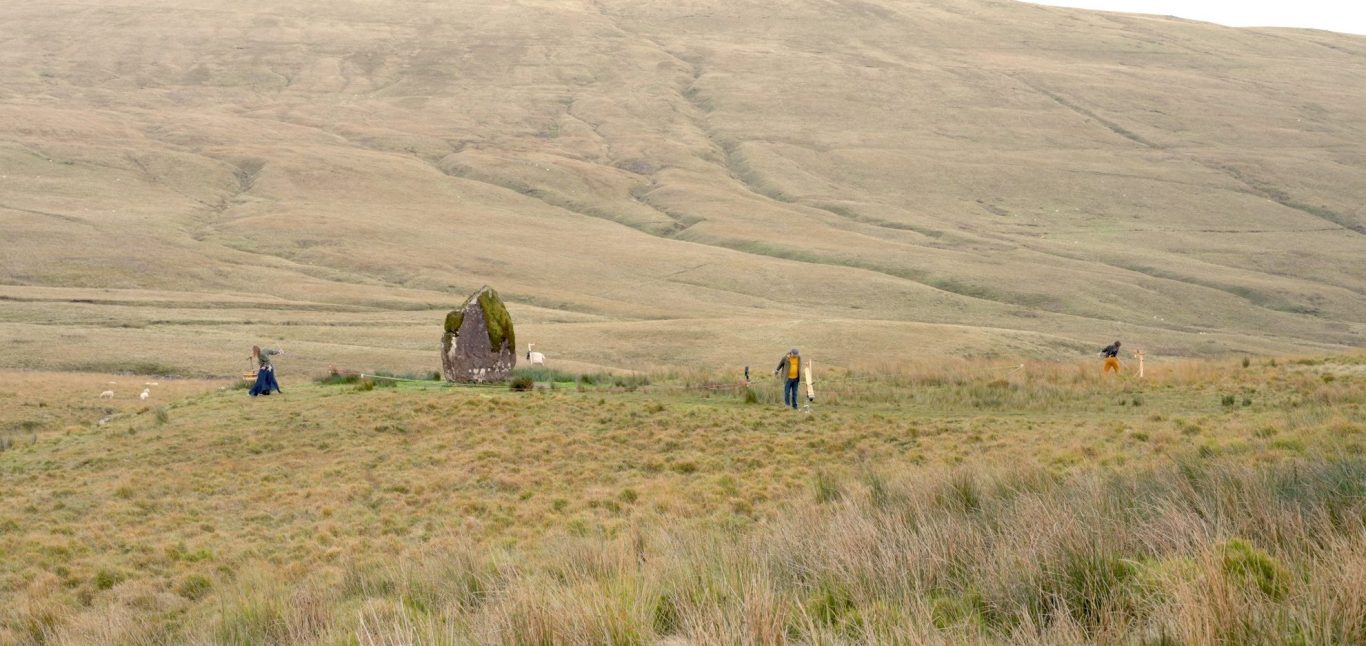
O bydded i’r hen iaith barhau / May the Language Endure for Ever, 2025. Site-specific performance.
Tsubasa Kato
In his on-going performance series Songs While Bound, Tsubasa Kato invites professional musicians to perform in a particular way of collaboration. During the performance, as these players are tied together with ropes maintaining a calculated distance, the movement of one individual creates a tension between each other – a tension that can intrude their playing of instruments. Being connected and controlled by ropes, the usual musical performance is turn into unfamiliar forms of bodily expression. Each performer’s intended motion – to play the right note or to hit the right beat – may be restricted unexpectedly by a fellow team member, and at the same time, it can unintentionally become an obstacle for the others. In other words, this performance that was meant to be ‘collaborative’ has become an event that is ‘non-collaborative’, or ‘anti-collaborative’.
In Performance Art Land 2025, Kato invited four Welsh musicians to play the national anthem of Wales with a range of traditional instruments. These instruments include harp, crwth, a bowed Welsh lyre since the European Middle Ages, tabwrdd, a double-skinned drum, and pibgorn, a reed instrument once popular with shepherds. What kind of site can best embody a country’s identity, past and present, and how might Kato’s specially structured performance respond to the its historical, cultural and political significance? May the Old Language Endure Forever was conducted in a typical mountainous landscape in South Wales. In the Brecon Beacons, the so-called Maen Llia is a nearly 4 metres high and 3 metres wide thin megalith erected on the moorland. Very possibly, a large proportion of the stone is below ground, so that it can endure wild Welsh weather for thousands of years. The purpose the stone remains unclear, for instance, establishing with its visibility from some distance, to mark a territory or to signpost travellers in ancient times. Official report suggests that the remains of a standing stone, often part of a larger cluster of monuments, probably dates to the Bronze Age (c. 2300 – 800 BC). This Scheduled Ancient Monument becomes ‘an important relic of a prehistoric funerary and ritual landscape and retains significant archaeological potential’.
Standing in the river valley of Afon Llia in the upland Fforest Fawr, the stone Maen Llia appears strikingly solitary, at the same time, minimalistically abstract, inviting any new interpretations. The musicians are positioned approximately 20–30 metres apart, around the Maen Llia, and connected by ropes in green and red – the primary colours of the national flag. The stone, here, is not merely a monument, but a symbol of Welsh legacies, and plays a legendary role in performance, amplifying unheard voice, and reimagining underrepresented stories within and beyond the region. In Kato’s performance, each instrument is stationed at a designated position, whilst the length of the rope between the musicians was calculatedly arranged – about a metre away for them to reach their instruments. In the same vein, as the national anthem begins with the pibgorn, the musicians both collaborate, and at the same time, struggle with one another to play the right the notes at the right time. Set against the desolate landscape of to the west of the Brecon Beacons, the song Hen Wlad Fy Nhadau (Land of My Fathers) is sung:
The land of my fathers is dear unto me,
Old land where the minstrels are honoured and free;
Its warring defenders so gallant and brave,
For freedom their life’s blood they gave.
Home, home, true I am to home,
While seas secure the land so pure,
O may the old language endure.
The piercing sound of the hornpipe, the rustic, buzzy resonance of the lyre, crystalline tones of the harp and the angelic voice of the singer strive to come together to form the national anthem. Through the mechanisms of performance, it is interrupted and fragmented, suppressed and distorted, yet, unified in sprit, and lifted by their collective power.