
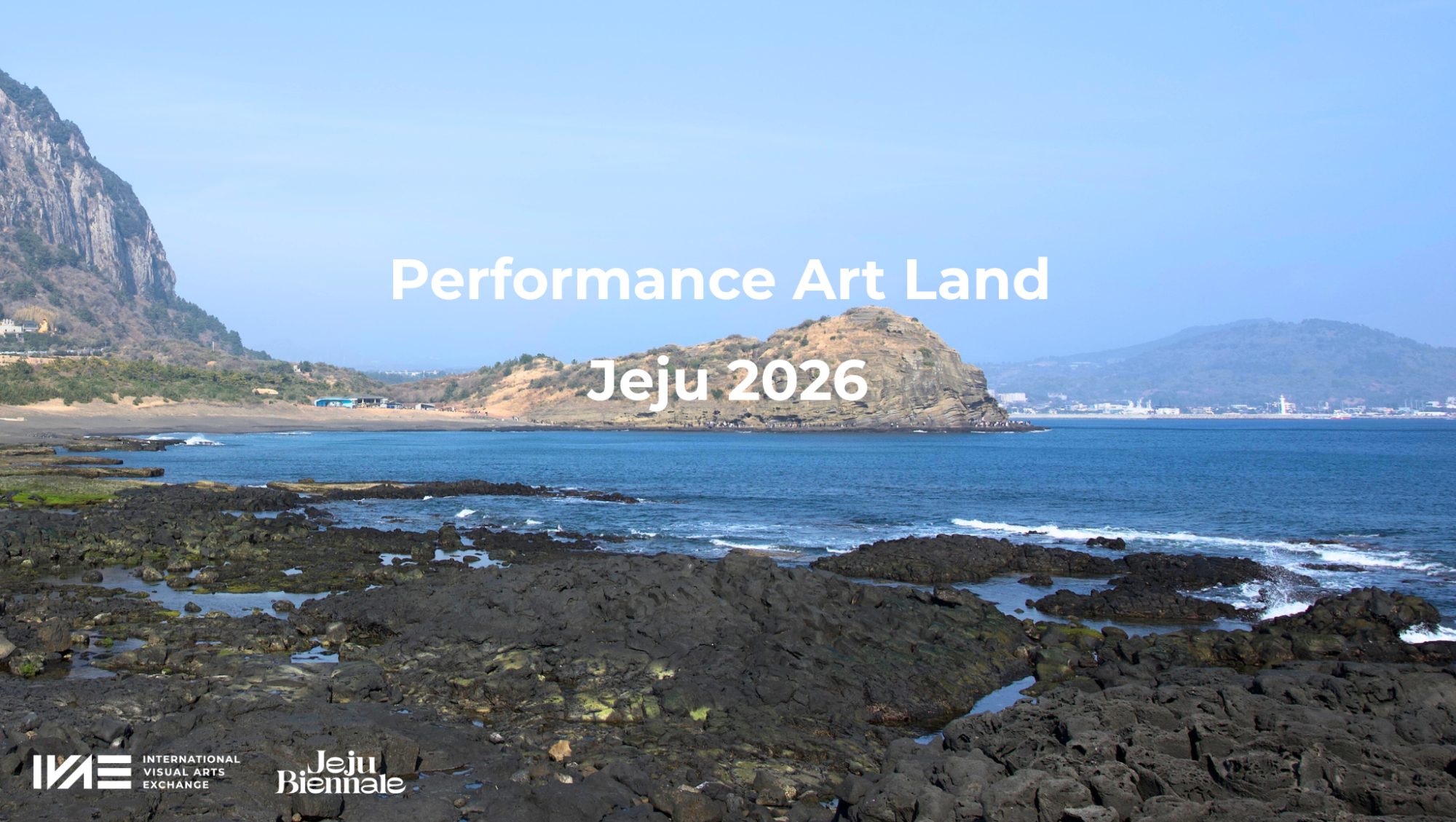
Open Call for Artists
Performance Art Land Jeju 2026
PAL Jeju
Performance Art Land (PAL) is a flagship project initiated by International Visual Arts Exchange (IVAE). In this ongoing initiative, we invite creative minds and bodies to develop site-specific projects. Working closely with the IVAE team, they realise contemporary art performances in a distinctive landscape, engage meaningfully with the local community, and reinterpret local culture for broader audiences.
Building upon the resounding success of the first edition of PAL in Wales produced in 2025, we are delighted to announce our support for an art project, specifically the commissioning of a new performance artwork on the island of Jeju in 2026, which extends PAL’s exploration of site-specific art. PAL Jeju 2026 is produced by IVAE and supported the 5th Jeju Biennale Team. We are now inviting proposals for one contemporary performance art project to be developed on-site in Jeju in May 2026, with its premiere taking place at the 5th Jeju Biennale from 25th August to 15th November 2026.
Theme
The PAL Jeju 2026 project will be closely aligned with the theme of the 5th Jeju Biennale, Iyahong: The Art of Metamorphosi. (See the appendix of the 5th Jeju Biennale theme for further details.) We encourage artists to collaborate closely with local residents and communities, as well as local artists or professionals, to make a contemporary performance artwork. This work will be developed, performed, and filmed in May and premiered at the 5th Jeju Biennale.
Jeju Island, known as the home of 18,000 deities, is characterised by its volcanic landscapes, rich local culture, and a history deeply intertwined with myth, nature, and ancestral legacies. It serves as a vital source of inspiration for contemporary art and creative practice. PAL Jeju 2026 promotes Jeju’s customs, history, culture, and distinctive features to a wider audience. We invite artists to explore the innovative and expressive potential of contemporary performance art within this ancient cultural landscape. We anticipate that artists will develop site-specific contemporary performance art concepts and plans centered on one or more natural landscapes in Jeju—landscapes that reflect Jeju’s culture and history and resonate with the 5th Jeju Biennale’s theme. Our aim is to forge meaningful connections — between Jeju’s geology and ecology and the sense of contemporary urgency; between local communities, everyday life, and deeply rooted cultural traditions — in order to amplify unheard voices, highlight resilience, and ignite cultural sparks that resonate with global audiences. This perspective encompasses, but is not limited to:
- Jeju’s mythology and its ongoing transformation;
- Jeju’s ecological systems and associated local legends;
- The representativeness and urgent relevance of marginalised or distinctive social groups within Jeju’s cultural fabric;
- Jeju’s folklore, spiritual beliefs, and intangible cultural heritage.
Support
The selected application will receive the following support:
- An artist fee of GBP £1,000;
- Production costs of GBP £2,000;
- A one-month residency accommodation in Jeju for research and production;
- An international exhibition: the premiere of the performance art film at the 5th Jeju Biennale, and further opportunities in Asia and the UK;
- Curatorial support for production.
Timeline
- March - April 2026, Open Call and Artist Recruitment;
- End of April 2026, Artist Announcement;
- May 2026, Artist Site Visits, Research, Production and Filming;
- June - July 2026, Artwork Editing;
- Late July 2026, Film Installation and Exhibition Testing;
- 25th August - 15 November 2026, the 5th Jeju Biennale Exhibition Period.
Submission
- We welcome independent Korean and international visual artists, as well as artist collectives or collaborative groups, to submit a complete art application;
- This art application is open to all formats; however, please submit the application in English only. The submission should consist of a single document, including a specific project concept, an implementation plan, a detailed budget breakdown, together with supporting materials, such as CV, portfolio, or relevant website;
- Please transmit the application document in a compressed file to the email address: info@ivae.org.uk, with the subject line specified as "PAL Jeju 2026 Application".
- The deadline for the submission of applications for this project is 12th April Sunday, 23:59 pm (Korea time);
- Upon reviewing the project applications, we will shortlist artists for an interview (in English). During the interview, artists may provide their own English interpretation or translation assistance if needed. The interviews will be conducted online on 20th April Monday;
- The invited artist will be announced by the end of April.
For more information or requests, please visit our website at: www.ivae.org.uk; or email us at: info@ivae.org.uk.
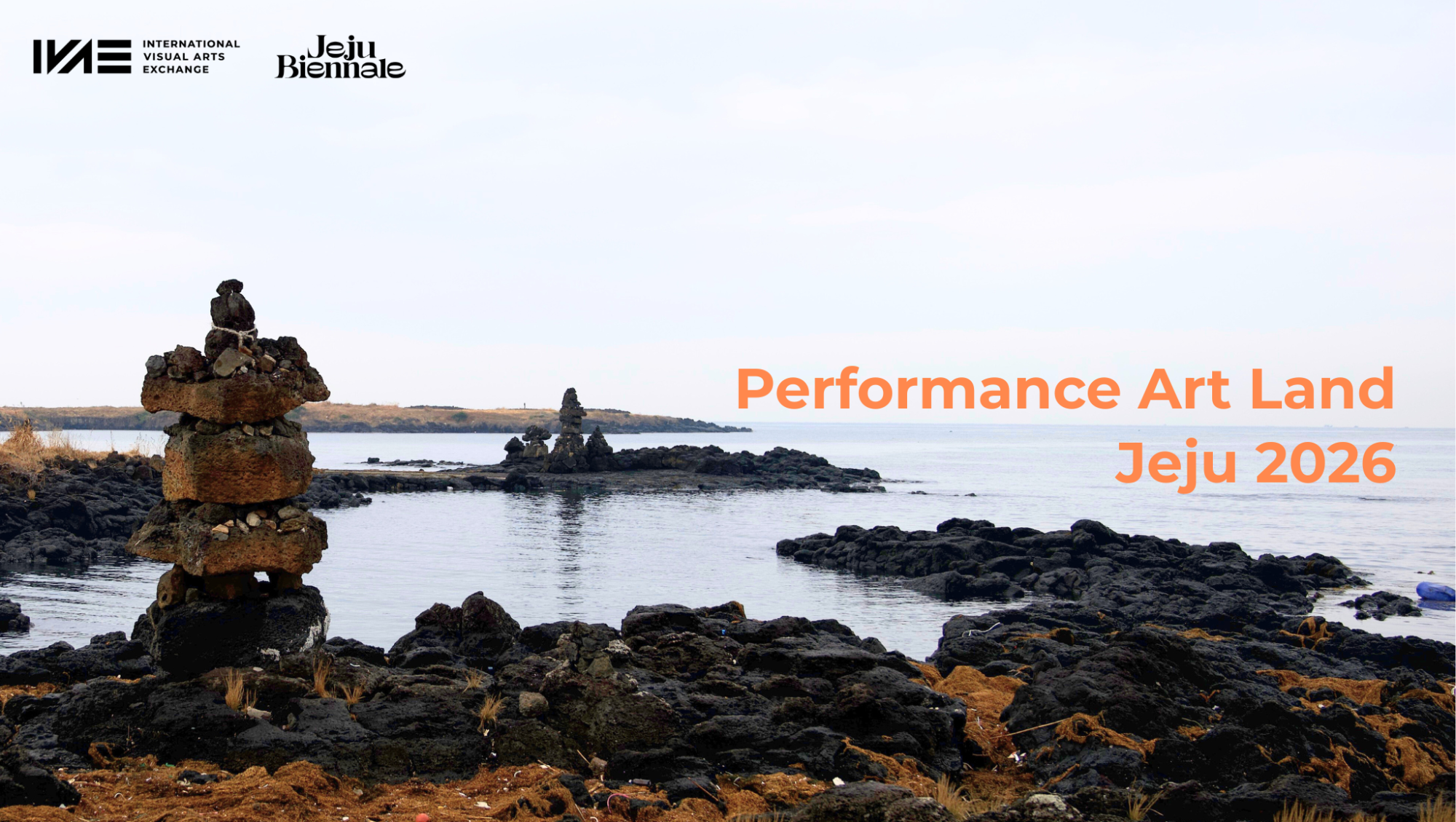
Appendix
The 5th Jeju Biennale
Iyahong: The Art of Metamorphosis
- Host: Jeju Special Self-Governing Province
- Organizer: Jeju Museum of Art
- Period: August 25 – November 15, 2026 (83 days)
- Venues: Jeju Museum of Art; Jeju Stone Culture Park; Jeju Art Platform; Art Space IAa; Remicon Gallery; and the Historic Old City Center (including Jejumok-Gwana, Gwandeokjeong Pavilion, etc.)
- Participating Artists: 70 artists/teams from 19 countries (Planned)
The Jeju Biennale, hosted by the Jeju Special Self-Governing Province and organized by the Jeju Museum of Art, is proud to announce its 5th edition this year. We would like to respectfully invite you to participate in the 5th Jeju Biennale and are pleased to provide the relevant details as follows.
Under the title “Iyahong: The Art of Metamorphosis”, the 5th Jeju Biennale explores the affective, metamorphic process where Jeju’s indigenous culture has encountered and merged with Northern civilizations. We examine this journey through three sub-themes: Stone, Human, and deities.
The Biennale’s core keyword, Iyahong, originates from the refrain of the Jeju folk song Iyahong Taryeong, capturing a cyclical flow of mixing and merging—entanglement and coalescence as a process of metamorphosis.
At the present civilisational turning point, the 5th Jeju Biennale proposes multiple post-human modes of being and an ecological horizon of the post-anthropological human, through the generative process in which Jeju’s geological conditions and an anthropocentric modernity have collided and coalesced.
The Biennale’s three sub-themes are Stone, Human, and Deities.
[Stone]
Jeju’s volcanic basalt shapes the island’s terrestrial attribute and everyday life. Northern megalithic traditions—seen in Jeju’s dolmens—interweave with this geology as part of Jeju’s cultural formation.
[Human]
Modernity may be read as a relentless pursuit of superhuman excellence in the Anthropocene. As a historical site of political exile (流配) from the Goryeo through the Joseon period, Jeju became a place where such entanglements were stripped back—yielding an aesthetics of Jol(拙), a becoming grounded in the milieu’s immanent forces.
[Deities]
Jeju’s polytheistic culture—often described as “18,000 deities”—holds the becoming of new cultural forms, where geological forces and human labours coalesce.
[Iyahong]
Fire/stone/earth, wind/sea/milieu, and people surge together into an affective, metamorphic Iyahong. From the Giant mother’s 'navel'(Omphalos), we hope to recover its immanent potential and its force of resilience.
Iyahong: The Art of Metamorphosis
As scattered elements gather, mingle, and merge into one, they metamorphose into an Iyahong-like refrain—life and matter reborn—resonating with the formation of Jeju aesthetics. The 5th Jeju Biennale unfolds across three thematic constellations: Stone, Human, and Deities.
[Stone]
Jeju is a land of stone, formed by volcanic activity around 1.7 million years ago. Basalt—rapidly cooled after eruptions, exposing its crystalline structure—formed the foundation of Jeju’s soils; over time, these geological conditions became embedded in daily life, shaping Jeju’s distinctive living culture. This interweaving is visible in the island’s emblematic stone walls and the Olle trails that connect them. It is also evident in the sinuous basalt stone-wall landscape known as “Heukryongmanri” (黑龍萬里; “Black Dragon Ten Thousand ri”). And, as seen in the island’s more than eighty dolmens shaped through contact with northern megalithic cultures, Jeju’s cultural formation includes a further convergence with megalithic tradition. Here, a new ecological principle for nature and humanity has taken root. This Biennale approaches Jeju as both a natural island and a civilisational island.
[Human]
Through Jeju’s history, we can reflect on a post-anthropological future that emerges from the present—arriving, taking root, and transforming. Modernity may be read as a relentless pursuit of superhuman excellence in the Anthropocene. Jeju—used as a site of political exile across the Goryeo and Joseon periods—became a place where such entanglements were stripped back, yielding an aesthetics of Jol (拙), a becoming grounded in the milieu’s immanent forces.
Key historical sources still referenced today include Sehando (歲寒圖) by Chusa Kim Jeong-hui (秋史 金正喜) — Sehando (歲寒圖) — as well as Yuhanlasangi (遊漢拏山記) by Choe Ik-hyeon (崔益鉉) —Jeju Pungtogi (濟州風土記) by Yi Geon (李健) — and Sok Eumcheongsa (續陰晴史). by Kim Yun-sik (金允植, 김윤식).
This Biennale, in particular, highlights Chusa’s perspective—shaped in Jeju, where he completed the Chusa style (秋史體) —by linking it to the aesthetics of jol (拙), principle found in Jeju letter paintings, folk paintings, and stone objects.
[Deities]
The process by which geological forces and human labors combine—becoming new aesthetic forms—also lives within Jeju’s polytheistic culture. Alongside well-known deities such as Baekjutto, Seolmundae Halmang, and Jacheongbi, Jeju has hosted 18,000 deities —nature spirits as changeable as the landscape, household deities, shape-shifting spirits, village gods, and deities from outside—coming and going, yet abiding.
Jeju, through its metamorphic force of Iyahong, can be understood as a post-anthropological ecological island where spirits and humans coexist, and where things and nature live in symbiosis.
The 5th Jeju Biennale seeks to unfold this “Iyahong aesthetics”—from Jeju to Korea and outward to the international sphere—together with artists working across local and global contexts.