
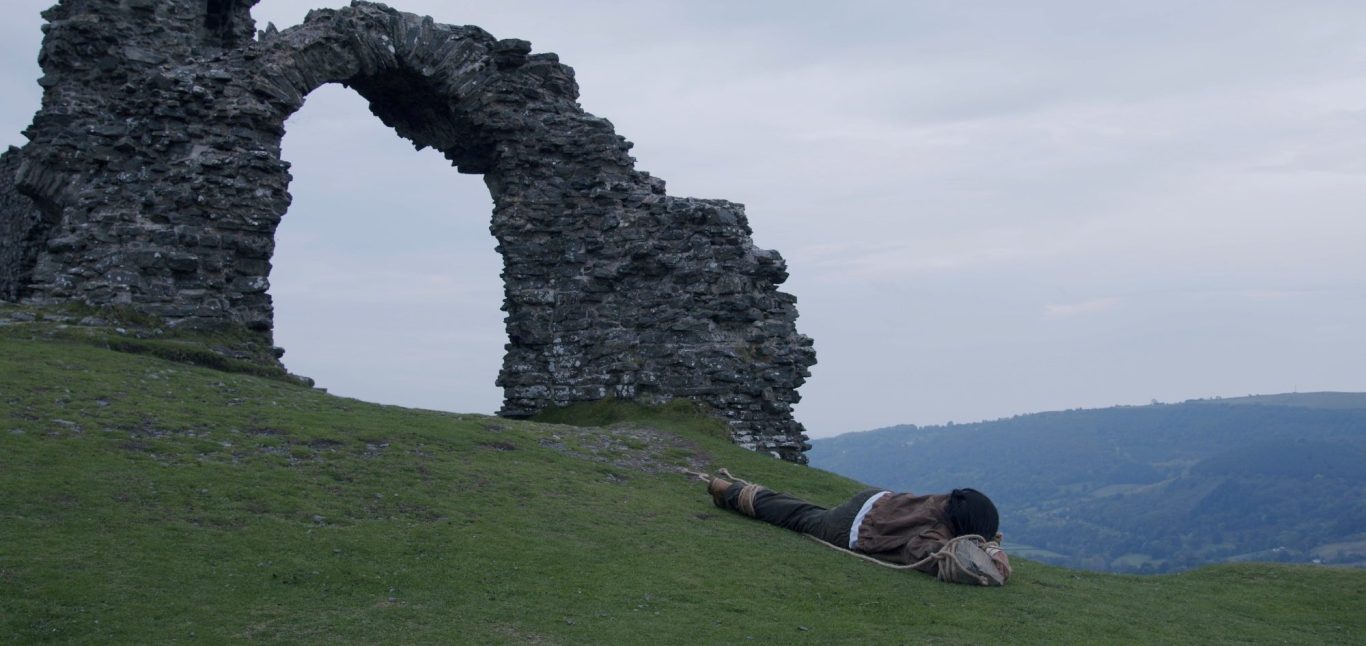
The Process of Stones, 2025. Site-specific performance.
Li Binyuan
As one of the oldest castles in Wales, Castell Dinas Brân (Crow’s Fortress) is believed to have been built in the late thirteenth century by the Princes of northern Powys. Served as a strategic fortress during a time of intense conflict with the English, it has been seen as a symbol of Welsh independence. In 1277, as Henry de Lacy (1251–1311) advanced with King Edward I’s (1239–1307) troops, the Welsh defenders set the castle ablaze to prevent it from falling into the hands of the invading English. The present remains of this medieval castle crown the summit of a prominent hill overlooking the town Llangollen. Though stark and weathered in appearance, the site remains iconic, representing the heritage and spirit of Wales, and its legendary scenery.
In Autumn 2025, Li Binyuan visited Wales for the first time. His project was developed from the initial encounter between the Chinese artist and Welsh landscape. To him, it was a foreign place; and vice versa, to the mountains and rivers, here came a foreign body. The meeting seems almost predestined. Coincidentally, the decade of 1270s was also politically critical in China, when the Yuan dynasty (1271–1368) that founded by Kublai Khan (1215–1294), grandson of Genghis Khan (1162–1227), was completing its conquest of China. When Castell Dinas Brân was destroyed in 1277, marking the beginning of the Edwardian conquest of Wales, the same year in China, the Southern Song dynasty (1127–1279) fled south in the final stage of Han resistance against the Mongol invasion, ultimately leading to the loss of Han’s political sovereignty within the next two years.
Li collected four pieces of rock along the mountain path – weighted approximately 20 kilograms in total, bound them respectively to both of his legs and forearms, and then started to crawl towards the top of the hill – Castell Dinas Brân. The four rocks became a heavy burden, both physical and cultural. It is unclear if it was the stones bearing the body, or the body bearing the stones – an arduous moment where fragility contrasts with permanence, and the ephemeral merges with the enduring. Each movement was made with tremendous effort, in the meantime, Li had to constantly reposition the stones attached to his limbs to continue the journey. During those few hundred metres of crawling through the castle ruins – a more than hour-long expedition, the panoramic site fell silent, leaving only the manic wind, his laboured breathing, and the scrape of the stones on gravel. What Li strove to carry is not just a collection of randomly found stones, but perhaps the missing fragments of the ruins, a revived past, and a reference point to envision our future. In Li’s performance, Castell Dinas Brân embodies the evolution of a nation and the spirit of its resilience, not necessarily any specific one, but rather, a shared human nation, whether in the East or the West in this temporary world.